
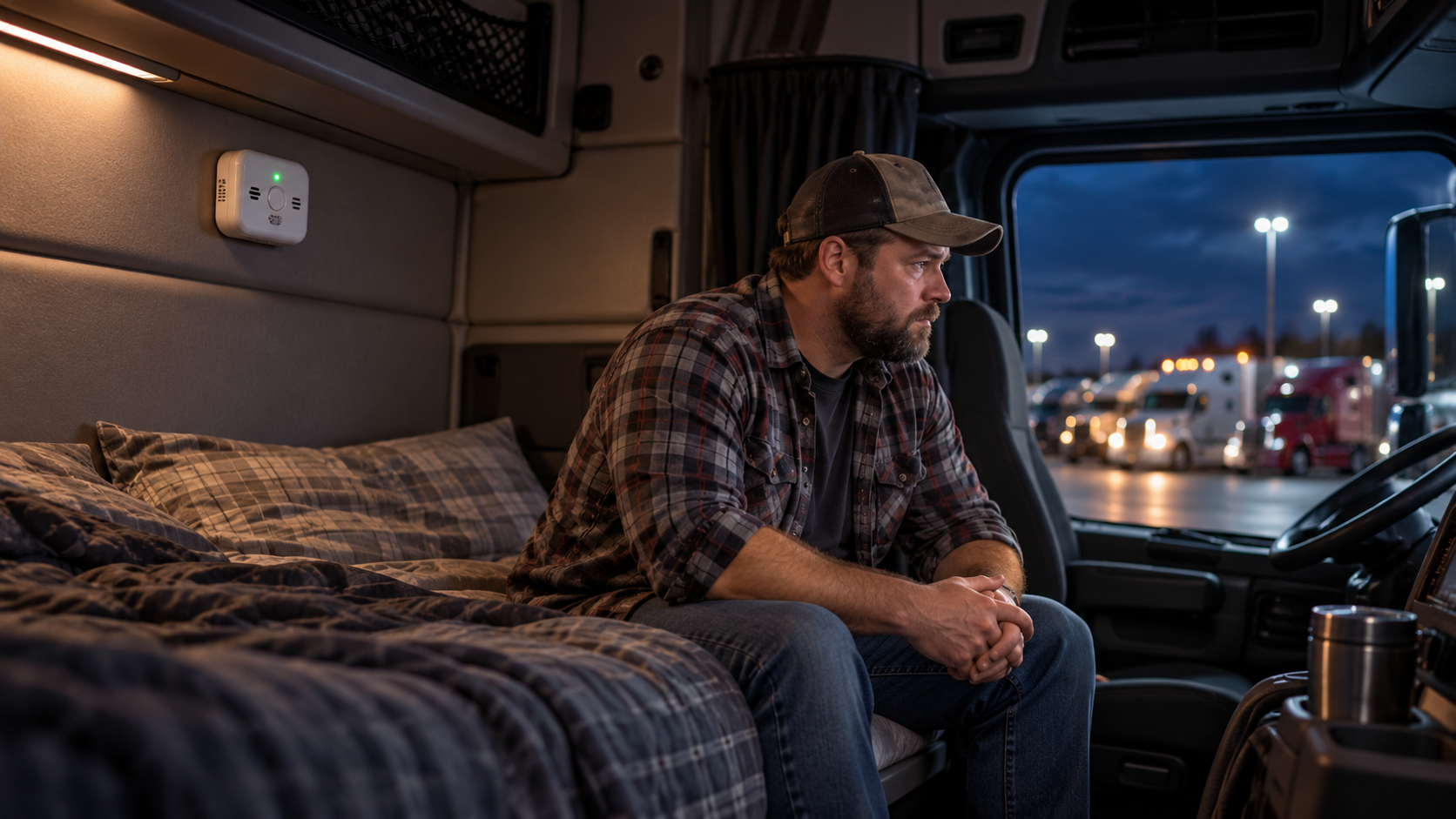
Truckers will spend money and time chasing problems they can see. A tire looks questionable, you check it. Something starts leaking under the hood, you look for the source. That mystery rattle you’ve been hearing for three states? Eventually it gets your attention, whether you want it to or not.
Carbon monoxide is a different kind of problem. You can’t see it, you can’t smell it, and you can be overcome before you understand what’s happening. It can be especially dangerous when you’re asleep in the one small space that serves as your bedroom, kitchen, and living room for weeks at a time.
Now a truck driver is asking why federal equipment rules don’t require the kind of warning device that could alert someone before a dangerous exposure turns fatal.
Todd Daum, a Cincinnati-based CDL holder who describes himself as a retired firefighter and fleet-safety professional, submitted a petition asking the Federal Motor Carrier Safety Administration to require carbon monoxide alarms in commercial vehicles equipped with sleeper berths. FMCSA’s open-petitions list shows it received his request on October 13, 2026.
This is a petition, not a finalized federal regulation. It has not made carbon monoxide detectors mandatory in every sleeper truck. The agency can consider the request, reject it, or move toward a formal rulemaking process.
Still, the question deserves attention. Particularly because the problem is not as theoretical as it might sound.
A driver died after a rest break in his truck
In January 2023, a 61-year-old truck driver in Washington State was resting in his tractor at a motor carrier terminal. He had been parked for roughly 24 hours and had spent the night in the sleeper while awaiting his next assignment.
According to a Washington State Fatality Assessment and Control Evaluation (FACE) investigation, the driver later walked into the terminal building visibly disoriented. He was struggling to stand and breathe. Coworkers helped and sought medical assistance, but he died after being taken to the hospital.
Investigators concluded that he died from carbon monoxide poisoning. Their report identified a single-burner butane cooking stove found in the truck as the most likely source. Testing did not find an engine or undercarriage exhaust leak, and monitoring of the bunk-heater system did not show a significant carbon monoxide concentration when investigators examined it.
Those details matter. It would be easy to turn the story into a blanket claim that the truck’s exhaust system failed, but that isn’t what the investigation found. The suspected hazard came from equipment used inside the living space.
The Washington investigators recommended battery-powered carbon monoxide alarms suitable for vehicles in cabs and sleeper berths, following the manufacturer’s installation and maintenance instructions.
One life lost is already more than enough reason to take the subject seriously. But one case also doesn’t tell us how common dangerous exposure is across the entire trucking fleet, what the most frequent sources are, or what the most effective regulatory design would look like. Those are fair questions, too.
The detail from Washington that should not get lost
The Washington State FACE report is particularly sobering because its investigation did not simply blame a leaking truck exhaust system. Investigators reported that a single-burner butane cooking stove found in the truck was the most likely source of the driver’s exposure. They reported no detected exhaust leaks in the engine or undercarriage, and air monitoring during their investigation did not find significant carbon monoxide near the sleeper’s bunk-heater exhaust. Those findings matter. They show why we shouldn’t automatically turn every carbon-monoxide incident into a story about a broken exhaust pipe.
The 61-year-old driver had been parked at his carrier’s terminal, waiting for another dispatch. He emerged from the truck struggling to walk and breathe, and other people tried to help. He was taken to the hospital but died. This is not an anecdote invented to make a policy debate scarier. It’s a documented fatality investigation, and the agency’s account underscores how quickly confusion and physical weakness can become part of the emergency itself. You can know something is wrong and still be unable to respond effectively.
The report also gives us a useful reality check: education and equipment belong together. Washington investigators recommended vehicle-rated alarms, restrictions on fuel-burning cooking and heating devices inside occupied trucks, driver training, maintenance checks, and attention to exhaust from nearby parked vehicles. That’s a more complete safety approach than buying one detector and treating it like a magic shield. Drivers need warning, but they also need to avoid creating the hazard in the first place. That emphasis on training isn’t limited to carbon monoxide; it’s also part of the bigger problem I covered in the CDL school training crackdown.
The strange gap in the current rulebook
Here is the part that caught my attention. Federal regulation 49 CFR 392.66 already restricts the dispatch or operation of a commercial motor vehicle when the occupants have been affected by carbon monoxide, when carbon monoxide has been detected inside, or when a mechanical condition is known that would likely create a carbon monoxide hazard.
That makes sense. If you know the cab is contaminated with carbon monoxide, you shouldn’t send the truck down the highway as if nothing happened.
But it also leads to a simple question: how does a driver know there’s carbon monoxide in the sleeper if there is no detector and no obvious sign?
You cannot rely on smell. You cannot reliably rely on feeling sick, either, especially when early symptoms overlap with a lot of ordinary trucking misery: headache, fatigue, dizziness, nausea, and confusion. The Centers for Disease Control and Prevention notes that carbon monoxide is colorless and odorless and that people who are sleeping can die before symptoms wake them.
The regulation tells people what not to do once the danger is known. Daum’s proposal is about giving drivers a better chance to know the danger is there in the first place.
It’s the sort of idea that sounds almost too obvious until you start asking what a mandatory standard should actually require.
What the existing rule does—and does not—cover
The federal rulebook already recognizes carbon monoxide as a commercial-vehicle hazard. Under 49 CFR 392.66, a commercial motor vehicle cannot be used if someone has been affected by carbon monoxide in it, if carbon monoxide has been detected inside, or if a mechanical condition likely to create hazardous exposure is discovered. That’s important, but it answers a different question from Daum’s petition. It tells operators when a truck may not be used. It doesn’t create a general requirement for a working detector in every sleeper berth.
Think about the gap this way: the regulation tells you what to do once there is evidence of a dangerous condition. A detector could supply that evidence earlier, especially while a driver is asleep and cannot notice symptoms or investigate. The argument for detectors is not that existing law has no interest in carbon monoxide; it’s that detection and prevention may need their own clearer standard. The counterargument is that a one-size-fits-all mandate could miss important equipment differences. Both deserve an actual technical discussion.
What the proposal would require
Daum’s request goes beyond tossing a household alarm in the sleeper and calling the problem solved.
As described in his petition and in reporting by *Overdrive*, the proposed rule would require vehicle-rated, battery-powered carbon monoxide alarms in both the sleeper area and the cab. The distinction between the two locations is intentional: the sleeper curtain can partly separate the air space, and a sleeping driver needs to hear the alarm over fans, idling, or other background noise.
The petition calls for drivers to function-test the alarms at least every seven days and for defective devices to be replaced before the truck is dispatched. It also asks carriers to keep installation and maintenance records, including details such as model, placement, testing, and replacement.
There are additional elements, too. The petition seeks restrictions on fuel-burning stoves and heaters used inside the cab or sleeper, driver training on carbon monoxide hazards, preventive maintenance for exhaust-related equipment, and a defined response after an alarm sounds.
Those are proposed requirements, not duties FMCSA has already imposed under this petition.
Daum estimated that vehicle-rated alarms available at retail could cost roughly $65 to $80 each, or around $130 to $160 for a two-alarm setup before fleet discounts. Those are the petitioner’s estimates, not a completed FMCSA cost analysis. A genuine rulemaking would need to examine equipment reliability, actual costs, replacement intervals, maintenance, and the effect on different types of operations.
I think that’s where the most useful debate begins.
A home alarm and a sleeper alarm are not automatically interchangeable
Most people know what a carbon monoxide alarm looks like: a little white box on a hallway wall. But a sleeper cab isn’t a hallway. It can spend hours shaking down rough interstate pavement, sit through freezing nights and brutal summer heat, and expose equipment to dust, humidity, and all the vibrations that come with a working commercial vehicle. A device intended for stationary residential use may not be rated for those conditions, and the wrong installation location can reduce its usefulness.
This is one reason Washington’s investigation recommended detectors made for vehicles and following the manufacturer’s instructions. When drivers ask what to buy, the better question is what has actually been tested for the environment they live in. Power source, temperature range, expected service life, mounting instructions, audible alarm characteristics, and replacement schedule should be part of the discussion. So should the warning about not improvising with fuel-burning appliances inside the sleeper. No amount of branding on a detector compensates for unsafe fuel use.
Companies considering a fleetwide policy should be careful about treating the cheapest available device as a complete solution. If half the fleet’s alarms fail under ordinary vibration or temperature swings, the policy will look great in a binder and accomplish very little on the road. And if a driver repeatedly gets false alarms without a clear response procedure, trust in the system can disappear. A realistic standard needs reliability as well as good intentions.
Why not just buy an alarm today?
Drivers don’t need a new federal rule to take carbon monoxide seriously. A properly selected and installed vehicle-rated alarm can be considered today, particularly alongside manufacturer guidance for the vehicle and any auxiliary heating or power equipment.
But a recommendation and a requirement are different things.
A company running hundreds of sleepers may already have a safety-equipment standard. Another may leave it up to the driver. A company driver might not be allowed to drill into a dash or mount equipment without approval. An owner-operator may want the added protection but be unsure which device is suitable for a truck’s temperature swings, vibration, and electrical setup.
A regulation could provide a common baseline. It could also introduce new costs, inspection questions, recordkeeping, and enforcement issues. It’s reasonable to ask how to make the standard effective without turning a safety device into another mountain of paperwork.
And the device needs to be right for the environment. A detector intended solely for a living room is not automatically the correct choice for a moving commercial vehicle. Truck cabs deal with vibration, seasonal temperature extremes, changing ventilation, and, in some cases, auxiliary power units and fuel-fired bunk heaters. Manufacturers’ specifications matter.
Most of all, an alarm cannot become an excuse to ignore an exhaust problem or use fuel-burning equipment unsafely. A working detector is a warning layer, not a license to turn the sleeper into a badly ventilated campsite.
Who pays, who installs it, and who checks it?
A federal equipment mandate sounds simple right up until somebody asks who is responsible for making it work. Does the manufacturer install the alarm when the sleeper is built? Does a carrier retrofit older equipment? Can a driver carry a personal detector from truck to truck? What happens when the batteries die during a trip, when a device gives repeated alerts, or when a truck changes owners? These are not arguments against detecting poison gas. They are the boring implementation questions that determine whether a good idea becomes an effective safety measure.
For company drivers, equipment responsibility needs to be unmistakable. If the alarm fails, there should be a straightforward way to report it, a policy on what happens until it’s repaired, and enough training that a driver knows an alarm is not something to silence just to get another hour of sleep. For small fleets and owner-operators, the purchase price is only part of the calculation. Installation, replacement, recordkeeping, and choosing a trustworthy product all matter. Regulators would need to weigh those realities against the potential safety benefit without pretending every truck is equipped and operated the same way.
A legitimate safety concern, with unanswered questions
It’s possible to support better detection while still insisting on good evidence before the government writes a final rule.
How many drivers have experienced significant carbon monoxide exposure inside occupied sleeper berths? Which sources account for the greatest risk: engine exhaust, APUs, bunk heaters, portable cooking devices, nearby vehicles, or a combination? Which detectors reliably alarm in the right range under trucking conditions? Where should they be mounted? What testing schedule actually improves safety rather than creating a box-checking exercise?
Daum has highlighted the lack of published overnight occupied-sleeper measurement data, according to *Overdrive*. That research gap is worth acknowledging. It means nobody should claim the industry has a precisely measured sleeper-cab exposure rate if the evidence doesn’t establish one.
It doesn’t follow, however, that a hazard should be ignored until every research question has been answered. We use preventive measures for risks that are serious, plausible, and difficult to notice, while continuing to study how best to reduce them.
The important point is to separate three things: what is already known about carbon monoxide’s danger, what has been documented in specific truck incidents, and what remains uncertain about how widespread the problem is in the fleet.
That distinction helps drivers evaluate this petition without either panic or complacency.
Good safety rules need good questions before they need slogans
The strongest version of this proposal would answer three questions. First, what exposure pathways actually show up in occupied sleepers, and how often? Second, which kinds of alarms reliably detect dangerous conditions in a commercial-vehicle environment? Third, what specific steps should a driver and carrier take when an alarm activates? Those sound like research questions because they are. A petition is how a rulemaking conversation can begin; it is not proof that every detail has already been worked out.
What drivers can do before FMCSA makes any decision
No one needs to wait for Washington to take a hard look at how they sleep in a truck.
The first step is to pay attention to the vehicle and equipment you already use. Exhaust leaks, damaged seals, improperly vented appliances, and makeshift heating or cooking arrangements deserve immediate attention. Any alarm you consider should be specifically rated and approved by its manufacturer for the intended vehicle use. The Washington FACE report is a useful place to start because its safety recommendations are connected to a documented fatal incident.
Drivers should also understand the symptoms. The CDC identifies headache, dizziness, weakness, upset stomach, vomiting, chest pain, and confusion as common signs of carbon monoxide poisoning. Those are not a diagnosis by themselves, but they are not something to dismiss when exposure is possible.
If you suspect carbon monoxide in the cab, move to fresh air and seek appropriate emergency assistance. Do not keep driving a suspected unsafe vehicle because you have a delivery appointment. A late load is inconvenient. A poisoned driver is a tragedy.
For carriers, the responsible move is to examine preventive maintenance, operator training, and whether existing equipment policies leave an avoidable gap. For owner-operators, it’s worth discussing vehicle-appropriate devices with a qualified installer or manufacturer rather than grabbing the cheapest detector on the store shelf.
None of this should be mistaken for a claim that a particular detector installation already satisfies some future rule. There is no final rule from this petition to satisfy.
If an alarm goes off, the response cannot be “five more minutes”
The Washington safety bulletin recommended that drivers whose carbon monoxide alarms activate park, exit the vehicle, get into fresh air, and have the truck checked for leaks before using it again. If someone feels poisoned or is having symptoms, call 911. CDC’s general guidance likewise treats suspected exposure as an urgent safety concern. The response should never be to crack a window, mute the alarm, and assume the problem has solved itself. A source may still be producing gas, and a driver who is already confused or dizzy may not be making good decisions.
A carrier can make that response much easier before anything happens. Drivers should know the emergency contact number, where to report a CO alarm, and what the company expects regarding repair or towing. New hires can be shown how the device sounds and what the display means. Dispatch should know that an alarm is a safety event, not an invitation to debate whether the load will still make an appointment. That’s not a guarantee against every exposure. It’s the kind of basic preparation we already demand for other equipment emergencies.
The rulemaking question is bigger than the detector
For a lot of drivers, the sleeper is the only private space they have on the road. It’s the place where they try to recover from eleven hours of driving, noisy parking lots, schedule changes, and the constant pressure to keep moving. What happens inside that space matters just as much as the condition of the truck when it’s rolling.
Daum’s petition forces an uncomfortable but useful conversation. We regulate equipment that helps a truck stop, steer, signal, and avoid accidents. Should we also establish a baseline for a device that could wake a sleeping driver when the air in the cab becomes dangerous?
I can see the argument for doing more. I can also see why FMCSA should take a serious look at equipment specifications and real-world fleet impacts before writing regulations. Those aren’t contradictory positions.
What I don’t think makes sense is waving away the entire subject as another needless gadget. Carbon monoxide doesn’t care how much experience you have, how well you maintain your truck, or whether your dispatch office thinks your load is important.
Would you support mandatory vehicle-rated carbon monoxide alarms in sleeper trucks, or do you think this should remain a company and driver decision? And if you already have one in your cab, I’d be curious to hear what type of device you chose and why.