Some roadside stories remind you why people still matter
Trucking can make you cynical if you let it. Spend enough time watching cars dive across lanes, waiting at docks where nobody seems to know you exist, and listening to people argue about whose fault the traffic is, and it’s easy to decide that consideration for other people is becoming a lost art.
Then something happens on the highway that doesn’t fit that gloomy picture. A stranger is in immediate trouble. Other strangers stop. Nobody has time to organize a committee or write a policy statement. They just try to help.
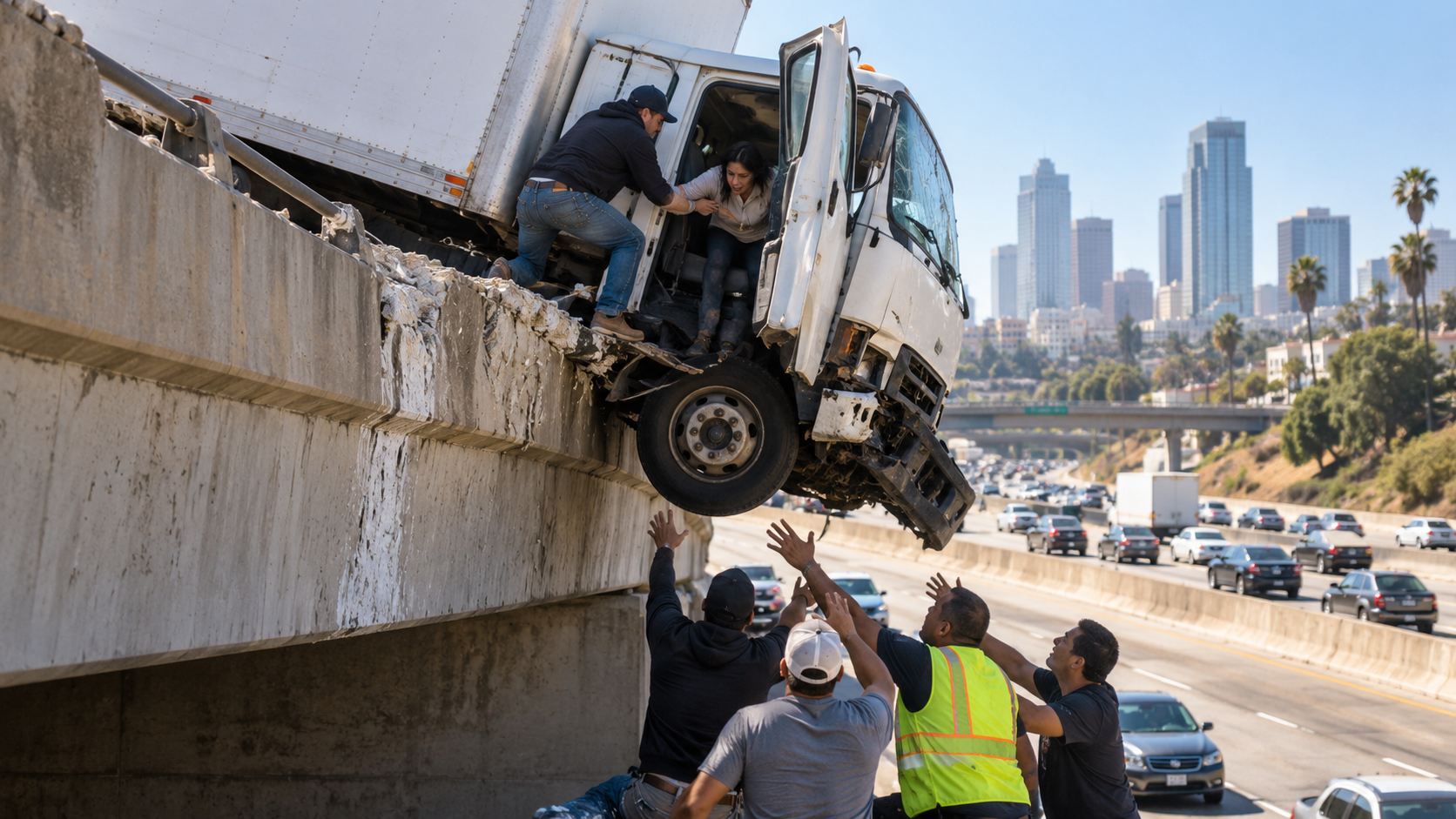
On October 20, 2026, a crash on Interstate 5 near Washington Street in San Diego left a moving truck hanging over a center divider with its cab on fire. Four people in a sedan were hospitalized, and the truck driver was thrown from the vehicle, according to local officials quoted by NBC 7 San Diego. A passenger remained in the truck, facing a terrifying escape.
Video showed bystanders and a responding officer holding a blanket below the dangling cab as the passenger climbed out and dropped toward the people waiting underneath. The image is dramatic. The more important story is the split-second decision by ordinary people to help somebody they had never met.
It’s the kind of moment that deserves space in a conversation about trucking and the highway. Not because the outcome erases the danger, or because we should encourage people to rush into unsafe scenes, but because too much road coverage focuses only on the worst decisions people make. Sometimes the defining decision is somebody choosing not to look away.
What happened on Interstate 5
According to NBC 7 San Diego’s October 20 reporting, the collision involved a sedan and a box-style moving truck on northbound Interstate 5 near Washington Street in the Mission Hills area at approximately 10 a.m. The truck ended up across the center divide, its box section remaining above while the cab hung into the lower roadway area.
San Diego Fire-Rescue said the cab was on fire when firefighters arrived. The crash damaged the divider and spilled fuel across the roadway. Emergency responders and highway crews faced the difficult task of protecting people, handling the fire and fuel, stabilizing the scene, and eventually removing the truck. The interstate was affected for hours, with multiple lanes closed on both sides.
Local authorities reported that the truck’s driver had been ejected into traffic lanes during the collision. A passenger remained inside and was helped out through a window. Both occupants of the truck reportedly declined medical evaluation at the scene. Four occupants of the sedan were transported to the hospital. The public reporting did not establish the cause of the collision, and no fair account should assign blame without reliable findings.
This is also where accuracy matters even in a feel-good story. Some early trucking coverage described the man escaping the cab as the truck driver. Reporting that explicitly cites CHP identifies him as the passenger. The distinction is worth correcting rather than repeating the mistaken version simply because it appeared in a popular headline.
The original video is credited to witness Arash Samiei and distributed by Storyful. We can describe what the footage shows and link to authorized coverage without reproducing somebody else’s video or assuming we have a license to use it. A strong story doesn’t require taking a clip from social media and uploading it as our own.
The moment strangers decided to help
Imagine driving through dense San Diego traffic and suddenly seeing a truck hanging partly over the opposite side of a divided freeway. There’s fire, confusion, possibly fuel on the road, and a man still trying to get out. Most people would have only seconds to assess what they’re seeing, and nobody is guaranteed to make a perfectly informed decision in such circumstances.
Video published by news organizations shows a small group gathered below the suspended cab, holding a blanket as the passenger climbed out. An officer was among those near the escape. It’s an improvised response by people trying to reduce the impact of a fall in an extraordinary situation.
It’s important not to turn that footage into a how-to demonstration. A blanket is not professional rescue equipment; an unstable vehicle, active fire, fuel spill, and live traffic can endanger bystanders as well as the person trapped. What made sense to people confronted by this specific emergency should not be presented as a routine technique others should copy.
But the human impulse deserves recognition. People saw somebody who was in trouble and tried to help. One person could have driven on. Another could have watched from a safe distance. Instead, a few individuals came together and acted in the seconds available to them.
Roadside rescues are often remembered for the spectacular image: the ladder, the rope, the fall, the fire. I think the image that stays with drivers is the one where ordinary people suddenly become a team. They may never speak again. They may not even learn one another’s names. For a brief moment they shared a simple goal: get that man out of there.
That doesn’t make them superheroes immune to risk. It makes them people who tried to do something decent in a frightening situation. There’s room to appreciate that without exaggerating what they accomplished or pretending there weren’t consequences for the people in the sedan.
What actually makes a good Samaritan?
The phrase ‘good Samaritan’ gets tossed around whenever someone stops by the road. Sometimes it’s earned by a meaningful act. Sometimes the person merely happened to be nearby. What strikes me about this case isn’t the label; it’s that the people gathered with a practical intention and tried to cooperate under pressure.
Every driver has had an occasion when a stranger changed the tone of a terrible day. Maybe a veteran walked over to help diagnose an air-line problem. Maybe someone guided a nervous rookie into a difficult dock without making a show of it. Maybe a motorist stopped with a flashlight or a driver helped move debris away from a shoulder. Those ordinary events never become national news, but they matter to the person receiving help.
Over-the-road work can be isolating. You pass through communities where nobody knows who you are, sleep in places you’ll never visit again, and spend hours thinking through problems alone. The small rituals of cooperation—an honest parking tip, a warning about a closed road, a conversation over coffee—make the profession feel less anonymous.
That is why the San Diego story belongs in a trucking publication even though the central act of help came from a mixed group of people on the roadway. It’s a reminder that the road is a shared space, not a war between professional drivers and everyone else. People can make terrible choices, and people can make generous ones. Sometimes both realities appear in the same news cycle.
The best response to the rescue isn’t to romanticize danger. It’s to recognize the value of people looking out for each other, and to think about how we do that responsibly in the ordinary situations we face every day.
Helping without becoming another emergency
If you witness a serious highway crash, the first job is not to become another casualty. Move your vehicle only when it is safe to do so. Avoid creating a secondary collision. Call 911 or the appropriate emergency service and give the clearest location you can. Keep yourself out of moving traffic and away from obvious fire, leaking fuel, unstable equipment, and power lines.
Official emergency-response guidance often emphasizes scene safety before intervention. The precise right action depends on the situation and training. A bystander who is not trained in rescue should not climb onto a burning or unstable vehicle because a dramatic video made it look straightforward. A person may be able to do far more good by immediately reporting the location, keeping others away from danger, and following a dispatcher’s directions.
Commercial drivers sometimes have advantages in spotting an incident: a high seating position, familiarity with mile markers, and experience recognizing traffic hazards. Those same drivers also operate large vehicles that are difficult to stop or park safely on a congested road. An impulsive attempt to help can create a new problem if a tractor-trailer is left blocking a travel lane or emergency access.
A practical lesson is to know what information emergency dispatchers need. Identify the interstate and direction of travel, nearest mile marker or exit, number of vehicles if visible, and obvious hazards such as fire or fuel. Avoid speculation about injuries or fault when you don’t know. Give concise observations and let trained responders make decisions.
If your company has incident-response procedures, become familiar with them before a crisis. Knowing how to report a hazard and preserve your own safety is more useful than imagining you’ll improvise flawlessly when adrenaline takes over.
The San Diego participants acted amid an extraordinary event. Appreciating them doesn’t require anyone else to imitate every detail of their response. Respect for the people involved should include respect for how dangerous the scene was.
There were other victims, too
It’s easy for an uplifting video to become so focused on the escape that the rest of the crash disappears. Four people in the sedan went to the hospital. Their experiences are part of the story, too. The publicly available reports did not provide a complete medical account for those four people, and we shouldn’t assume their injuries were minor simply because the clip centers on somebody else.
The truck driver being ejected is also a sobering detail. Vehicles can sustain forces that injure people in ways outside observers don’t understand. A person declining medical evaluation does not mean nothing happened, nor does it provide a basis for casual commentary about what should have occurred.
Emergency crews had to manage flames, spilled fuel, damaged infrastructure, and major closures. Travelers were delayed and responders worked to make the roadway safe again. There is no reason to treat those consequences as unimportant just because one moment of the event offered a hopeful image.
A good news story can hold more than one emotion at once. We can be grateful that the passenger got out. We can recognize the people who helped. We can hope everyone injured receives proper care. And we can still want investigators to establish exactly what caused the collision, without rushing to blame a driver or the sedan’s occupants.
In that sense, ‘good vibes’ shouldn’t mean an escape from reality. It should mean finding an authentic example of people doing something good inside a complicated and sometimes painful event.
The kind of road culture worth protecting
One of the things I love about old truck-stop conversations is that they’re not scripted. You sit down next to drivers you don’t know, and somebody mentions a place to park, a road that’s a nightmare in bad weather, or a mechanic who helped them out. Before long everybody has an opinion and a story.
You may spend an hour laughing at the terrible decisions people make. Then somebody quietly tells you about a stranger who helped when they were stranded. The mood changes, and the conversation becomes something you remember for years.
That blend of humor, practical knowledge, disagreement, and decency is what makes trucking feel like a community instead of an endless succession of loads. It is also what gets lost when every online conversation becomes a competition to be angrier or more sarcastic than the last person.
The San Diego rescue reminds us that a community isn’t defined only by people who hold the same license. It is defined by how people behave when somebody needs help. A driver can learn something from a motorist, and a motorist can learn something from a driver. It doesn’t require everybody to agree about speed limits or merging etiquette.
The more people talk, the more likely somebody is to say, ‘You know, something like that happened to me once.’ Those experiences can contain useful lessons that never make it into official reports. A story about a rescue can become a discussion about where to stop, when to call for help, how to avoid secondary crashes, and why ordinary kindness still deserves a place in the conversation.
If a viewer comes away from this story simply feeling a little better about the people sharing the highway, that’s something. If they also think more carefully about how to help safely at a wreck scene, that’s even better.
Not every hero wears a reflective vest
Some rescue stories involve trained professionals doing what they’ve prepared to do for years. Others involve bystanders who are suddenly standing in the right place at an awful time. The two are not interchangeable. Firefighters, police, and emergency medical personnel have training and equipment that ordinary motorists usually don’t. They are essential to bringing dangerous situations under control.
But the fact that professionals have a critical role does not diminish the people who tried to help before the scene was secure. In the video, people gathered and held a blanket. That simple act may be what millions of viewers remember from the incident. It is visible proof that strangers can cooperate without needing to know one another first.
We should be careful with language, though. Calling someone a hero is easy. Knowing precisely how much an action changed an outcome can be impossible without a more detailed account. The footage shows an attempt to cushion an escape; it does not give us a medical assessment or a complete sequence from the perspective of everyone at the scene.
For the people involved, the event may be remembered less as a viral clip and more as a terrifying few minutes. If we ever get to hear directly from them, I’d rather ask what they saw and why they acted than force a heroic narrative onto their experience.
There’s an important difference between honoring someone and using them as a prop for a feel-good headline. The first requires curiosity and humility. The second just requires a share button.
What I’d ask the drivers at the counter
If this story came up around a diner counter, I wouldn’t be surprised if the first response was somebody explaining how quickly a wreck can shut down I-5. Then another driver would want to know how the truck got into that position. Someone else would mention a time they saw a stranger pull another person out of danger. Within five minutes, the original story would have become a dozen others.
That’s not a distraction. It’s how practical experience gets shared. The useful part is making sure the stories stay tethered to what people actually witnessed rather than becoming folklore that’s impossible to verify.
Here’s the question I’d put to people who’ve spent years driving: have you ever been helped by a complete stranger on the road? Not necessarily during a dramatic rescue. Maybe you were stuck, lost, out of fuel, dealing with a flat, or simply having the worst day of your week. What did the person do, and do you remember anything about them?
And here’s the other side: have you ever stopped to help someone and learned afterward that the situation was more dangerous than you realized? What would you tell a rookie about protecting themselves while still looking out for others?
Those are the conversations I want more of in trucking. Not every driver has a spectacular rescue story. Most people have a small story of somebody being decent when they didn’t have to be. Those add up to a culture, and a culture can survive a lot of bad days if people keep choosing to participate in it.
A better ending than the usual road rage clip
There’s no neat way to wrap up a violent crash. People were injured, a truck caught fire, emergency responders faced a dangerous scene, and investigators still needed to do their work. It’s not a happy event, and no amount of uplifting commentary changes that.
But within it there was a moment worth recognizing: people who didn’t know one another tried to get somebody out of immediate danger. The image of strangers holding a blanket below a dangling cab is going to stick with a lot of viewers, and not because it makes a great thumbnail.
I hope it reminds people that the road is full of strangers who may turn out to be more decent than we expect. Every professional driver has reason to complain about bad behavior. We see enough of it. But if bad decisions are the only stories we tell, we eventually forget what the good ones look like.
Highway Bound should have room for both. We can call out reckless conduct, have serious conversations about accountability, and still celebrate people who step up when it matters. That’s a far more honest picture of life on the road than endless doom and gloom.
If somebody helped you during your career, tell me the story. If you’re comfortable, tell me what happened and what you learned. Maybe we can bring some of those experiences into future conversations, and maybe somebody who’s only been out here seven months will hear exactly the lesson they needed.
Because sometimes the thing that sticks with you isn’t the mile marker, the delivery, or the load. It’s the stranger who made a terrible day a little less lonely.
Sources and editorial note
Local reporting: NBC 7 San Diego (October 20, 2026); witness footage documentation: Storyful / Arash Samiei; follow-up coverage: The Auto Wire (October 26). Published reporting identifies the man who escaped from the cab as the passenger, despite contradictory wording in some earlier trucking coverage. The collision’s cause was not established in the cited local reports. Do not reproduce the witness video without appropriate rights.