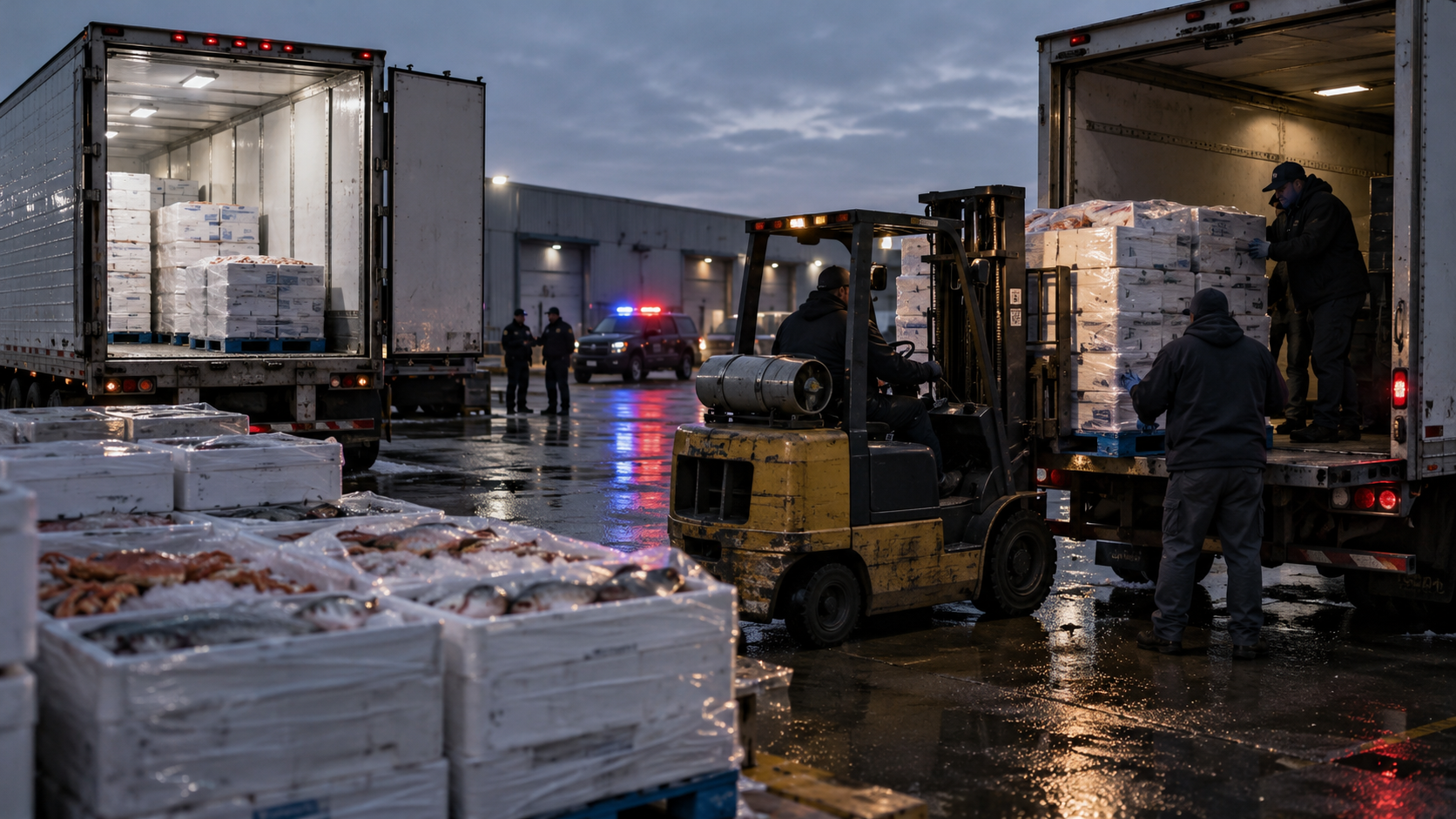
Somebody tried to steal more than a quarter-million dollars in frozen seafood in New Jersey, and the most disturbing part wasn’t the seafood, the box truck, or even the fact that the suspected thieves reportedly started moving pallets in plain sight.
It was the phone calls.
According to investigators, the legitimate tractor-trailer driver received calls and text messages from someone who claimed to represent the freight broker responsible for the load. The instructions sounded official enough that the driver headed to the location provided. By the time police arrived, people were transferring freight from the refrigerated trailer into another truck.
No stolen tractor or highway ambush. Just somebody pretending to be the right person on the phone and convincing a driver to bring freight to an unauthorized location.
For an industry that depends on constant communication among brokers, dispatchers, shippers, receivers and drivers, that’s a pretty uncomfortable story. And if your first response is “Well, the driver should have known,” I’d like you to explain exactly how you’re supposed to know which caller is legitimate when the person on the other end sounds like somebody involved with your load.
What Happened in North Arlington
On October 3, 2026, police in North Arlington, New Jersey, responded to a report of suspicious freight activity on Porete Avenue. When officers arrived, they found a refrigerated tractor-trailer and a 26-foot box truck, with people moving pallets of frozen seafood between them. The shipment weighed approximately 29,000 pounds and was valued at more than $273,000.
The products were primarily shrimp, along with salmon, conch meat and branzino. That’s a pretty substantial amount of seafood to have hanging around in a place that wasn’t the authorized destination. And unlike a few missing cases discovered during a routine inventory, this was an apparent effort to reroute part of an active commercial shipment.
According to the account published by News 12 New Jersey, investigators determined that the tractor-trailer driver had received communications from a person falsely presenting himself as affiliated with the legitimate freight broker. The driver was instructed to divert a portion of the cargo to the North Arlington location for a supposed transfer.
The crucial detail is that the person giving those directions did not actually represent the broker. The truck driver had been guided into a situation that, according to police, was part of an attempted theft.
Authorities arrested an 18-year-old Bronx resident, Jonathan Pollaguari, and a juvenile who were allegedly involved in the transfer. The adult suspect faced several charges, including theft by deception and conspiracy, as well as an accusation involving the participation of a juvenile. Those are criminal allegations, not convictions. FreightWaves’ October 9 report provides additional details on the charges and investigation.
Officers recovered the shipment before the suspected thieves could leave with it. That is a fortunate outcome, but it doesn’t answer every question about how the scheme developed. Investigators have not publicly identified the person who made the fraudulent calls, nor established how that individual obtained the information needed to make the instructions convincing.
Those gaps matter. It’s tempting to immediately conclude that somebody hacked a brokerage, bought credentials, compromised a load board or worked on the inside. Any of those possibilities might sound plausible in the current freight-fraud environment, but the public reporting does not establish which, if any, occurred in this particular case.
The Driver Didn’t Need to Hand Over the Keys
The part of this case that should concern carriers is how little direct control the apparent fraudster needed over the truck. If you can successfully impersonate someone authorized to change shipment instructions, you may not need to steal equipment at all. You can persuade a legitimate person to deliver the freight to the wrong place.
Trucking operations have always involved last-minute changes. Appointments get pushed. Receivers change dock assignments. A warehouse asks a driver to check in through another gate. A broker forwards a corrected address because somebody entered the wrong ZIP code. In a busy dispatch office, none of that necessarily sounds unusual.
That’s what makes shipment redirection particularly dangerous. Criminals don’t have to invent some outrageous story if the normal business already contains enough confusion to make a changed instruction plausible. The more rushed the day, the easier it is for everyone involved to assume the next phone call is just another irritating piece of logistical housekeeping.
And a truck driver is often at the very end of that chain. The driver may not know the shipper’s customer, the receiving company’s ownership, the broker’s internal staff list or which person authorized a revised stop. They know the load information they were given, the contact details available to them and what dispatch is telling them at that moment.
None of that excuses ignoring a suspicious change. But it does explain why fraud prevention has to be a coordinated business practice instead of a lecture delivered after a load goes missing.
According to reporting about the New Jersey case, the driver appears to have followed what he believed were legitimate broker instructions. Police haven’t publicly accused that driver of participating in the scheme. It’s important not to turn somebody potentially deceived by criminals into the villain because the internet needs an easy target.
Cargo Theft Has Moved Beyond Cutting Seals
To understand why this incident matters beyond the unusually expensive seafood, it helps to look at what cargo-theft investigators are seeing across the industry.
In its second-quarter 2026 analysis, Verisk CargoNet documented 677 supply-chain theft incidents across the United States and Canada. That was 26% fewer incidents than in the same quarter a year earlier. On its own, that might sound encouraging.
But the estimated value of the losses reached approximately $304.6 million, more than double the $135.7 million reported for the comparable quarter in 2025. A handful of extremely high-value cases helped drive that increase, so it would be misleading to say every stolen load suddenly doubled in value. Still, the results show why raw theft counts don’t tell the whole story.
CargoNet also reported that compromise-based schemes, including business-email fraud and shipment misdirection, continued to appear even while some forms of physical theft and non-delivery fraud declined. Seafood theft reports were among the categories that increased. None of those statistics proves the method used in North Arlington, but they provide useful context for why the industry is paying closer attention to identity-based attacks.
Think about how many businesses touch one shipment. There may be a shipper, a warehouse employee, a freight broker, a carrier dispatcher, a truck driver, a receiving company and a third-party tracking service. Each one communicates over email, phone, text or specialized software. Every handoff creates an opportunity for bad information to be accepted as authentic.
A fake instruction doesn’t need to look especially clever if it arrives through a channel everyone already trusts. That’s the real vulnerability: an apparently ordinary business message can change where hundreds of thousands of dollars of merchandise ends up.
The trucking industry has spent a lot of effort protecting trailers from physical theft. Locks, seals, cameras and GPS trackers can help with that. But what happens when nobody has to force open the trailer because the driver has been told to deliver it someplace else?
What a Driver Can Actually Verify
This is where the conversation needs to stay practical. It’s easy to tell drivers to verify everything. It’s less easy to explain how that works when you’re sitting in a crowded truck-stop lot, have three missed calls from dispatch and are trying to figure out whether the address on the bill of lading matches a facility with five separate entrances.
The FMCSA’s broker and carrier fraud guidance recommends independently confirming contact numbers, including checking the agency’s SAFER system and calling a number associated with the actual business rather than relying solely on contact information supplied in a suspicious message. The agency also warns that online search results and business listings can be faked.
That principle becomes especially important when somebody wants to change the destination or transfer a shipment. A text message that says “new drop location” should not automatically become the new operating plan, even if it mentions the correct load number. A person with access to a shipment number isn’t necessarily authorized to redirect the freight.
For carriers, a workable procedure might include requiring the dispatcher or broker account contact already on file to verify changes through an established channel, documenting the revised instructions, and making sure the shipper or receiving party agrees. For drivers, it means knowing who to call when an unexpected instruction arrives—and having company backing when the answer is “I’m not moving until this is confirmed.”
There also needs to be a sensible response when the information doesn’t line up. Nobody benefits from having a driver argue with a possible scammer over the phone while trying to navigate a busy industrial area. Find a safe place, contact the carrier or known broker representative, document the discrepancy and follow established incident-reporting procedures.
Not every unusual destination is fraud. Blind shipments, cross-docks and legitimate last-minute changes do exist. But that doesn’t mean a driver’s doubts should be brushed off with “Just do what the text says.” The more valuable the load, the more expensive that casual attitude can become.
The Responsibility Doesn’t Belong to the Driver Alone
Here’s the part that tends to get lost whenever one of these cases goes viral. Truck drivers are responsible for following lawful instructions, securing their equipment and using good judgment. But they are not an entire fraud-investigation department on wheels.
If a broker has unreliable contact information, a dispatcher doesn’t confirm changed delivery locations, a shipper releases cargo without adequate identity checks, or a carrier fails to establish clear escalation procedures, that’s not a problem one driver can solve by being a little more suspicious.
Companies need systems that make the right behavior possible. A driver who calls to verify a change shouldn’t be treated as a nuisance. They shouldn’t have to choose between missing an appointment and obeying an instruction they believe might be fraudulent. And they certainly shouldn’t discover after the fact that the only approved contact number was sitting in an email chain somebody else never forwarded.
The North Arlington incident appears to have ended with the freight recovered, two people arrested, and the legitimate driver not publicly charged in connection with the attempted theft. That’s better than another six-figure loss disappearing into a network of warehouses. But the story is still a warning, because the same tactic could be attempted against ordinary groceries, electronics, pharmaceuticals or industrial equipment.
The exact commodity almost doesn’t matter. It just happens that this time the cargo was enough frozen seafood to stock an unusually ambitious restaurant.
The Most Dangerous Part Was the Familiar Voice
There’s no shortage of things that can go wrong while hauling freight. Bad weather, careless motorists, mechanical problems, appointment delays and the occasional broker who apparently believes a truck can cross three states in eleven minutes. Drivers already have enough to think about without adding criminal impersonation to the checklist.
But that’s exactly why this case deserves attention. It demonstrates how freight can be placed at risk without the thief ever climbing into the cab. The fraud begins by convincing a legitimate participant in the shipment that the instructions have changed.
We still don’t know who orchestrated the phone calls in New Jersey or how the shipment information was obtained. We do know that police reported a diversion attempt, interrupted the transfer, and recovered roughly $273,000 worth of seafood. Those are substantial facts, and they’re enough to support a very practical lesson.
The next time a new voice gives you a new destination, it might be legitimate. It might also be somebody trying to make your truck do the stealing for them.
Verify the change through a known, independent contact—not just through the person who asked you to make it.
And for the companies that expect drivers to make that call, make sure there’s actually somebody on the other end who can answer it.
Sources and further reading
FreightWaves — October 9 report on the New Jersey seafood diversion
News 12 New Jersey — North Arlington police account
SeafoodSource — independently reported incident details
CargoNet — Q2 2026 cargo-theft trends
FMCSA — broker and carrier fraud prevention