Most truck drivers spend their day trying to avoid accidents. That means watching mirrors, leaving space, checking blind spots, anticipating the driver who just realized their exit was three lanes away, and occasionally wondering whether the general public received its license out of a cereal box.
In New Orleans, federal investigators uncovered something considerably worse than ordinary bad driving: people intentionally creating collisions with commercial trucks, then using those crashes to pursue fraudulent legal claims.
One of the attorneys involved has now been sentenced to federal prison.
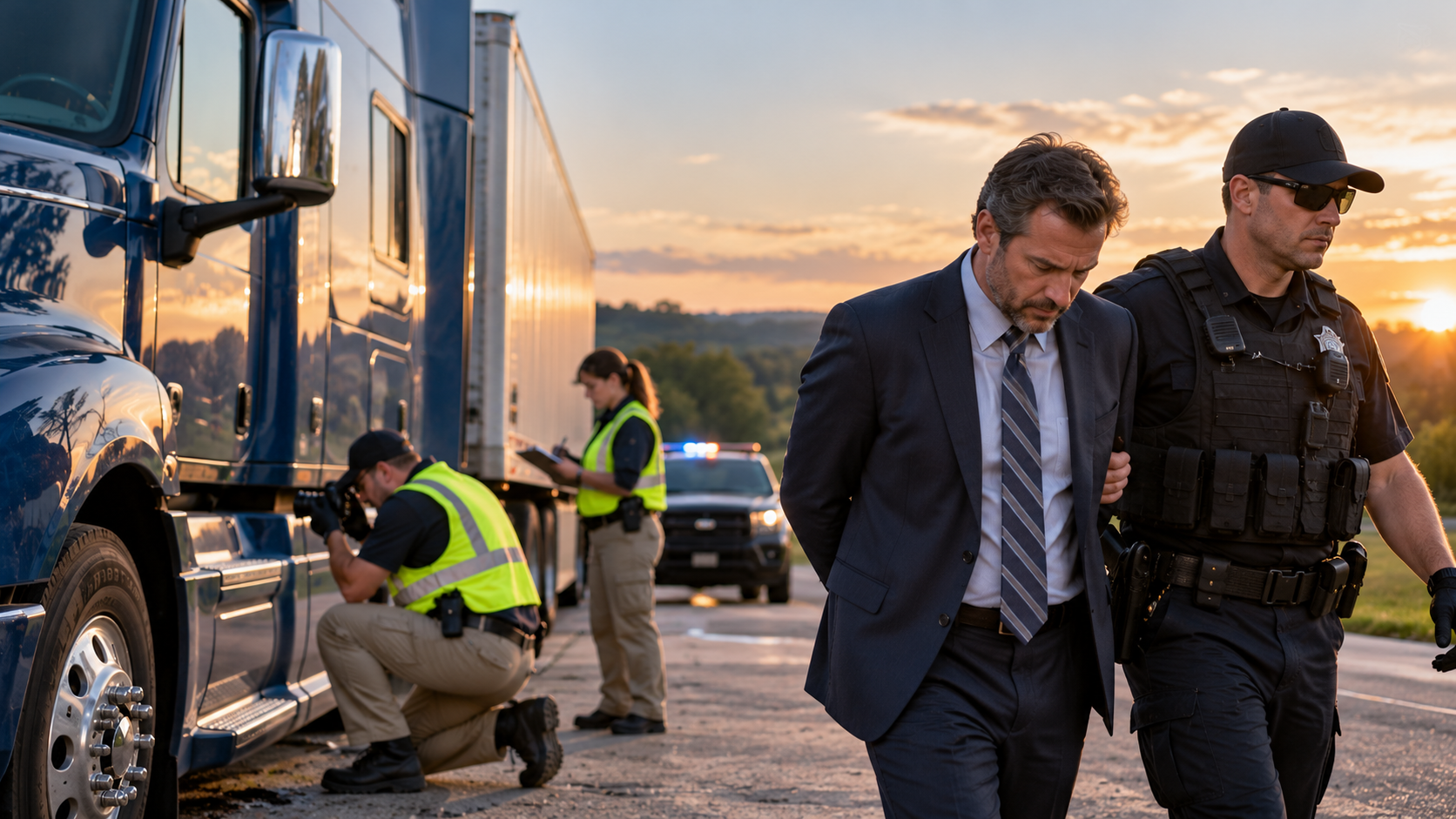
According to the U.S. Department of Justice, former personal injury attorney Danny Patrick Keating Jr. was sentenced on October 15, 2026, to 32 months in prison, followed by three years of supervised release. The court also ordered $657,405.34 in restitution. Prosecutors said he had pleaded guilty to conspiracy to commit mail and wire fraud in a scheme involving staged collisions with tractor-trailers in the New Orleans area.
This isn’t a rumor pulled from a Facebook comment section. The sentencing, admitted conduct, and financial figures are laid out in a DOJ announcement dated October 16.
And the numbers are hard to wrap your head around.
What Keating admitted
Federal prosecutors said Keating knowingly paid Damian Labeaud for 31 staged accidents involving tractor-trailers. Keating represented 77 plaintiffs involved in those staged collisions and settled 17 of the 31 cases.
In the original charging allegations, prosecutors said Keating and clients received approximately $1.5 million in settlements tied to those claims, with approximately $358,000 retained as his attorney’s fees. It is important to distinguish those charging figures from the sentence itself: the court’s restitution order was $657,405.34.
Keating also admitted filing lawsuits that misrepresented who was driving the vehicles, who caused the crashes, and whether injuries had occurred. The DOJ said some clients provided false deposition testimony and that settlement demands were sent through the mail as part of the fraudulent activity.
Read that again, because it helps explain why this case is so infuriating. The collision wasn’t simply followed by a questionable insurance claim. Prosecutors described a system in which the accident, the story afterward, and the legal process could all become parts of the same scheme.
That’s a long way from somebody exaggerating the pain in their neck after a fender-bender.
It’s also worth being exact about another number circulating in coverage. The DOJ said 63 defendants had been charged in the broader federal investigation as of its October 16 announcement. That does not mean Keating personally represented 63 defendants, and it does not mean every person charged has been convicted. Those numbers refer to different parts of a much larger case.
How a manufactured wreck becomes a legal claim
The part that separates this case from an ordinary traffic crime is what prosecutors described happening afterward. The deliberate collision was only the beginning. According to the Justice Department, Keating admitted paying Damian Labeaud for staged accidents and then representing people connected to those events. Claims were pursued in court, settlement demands were mailed, and the lawsuits falsely described material details, including who had been driving and who caused the collisions. In many cases, the DOJ said, clients gave false deposition testimony. That is a chain of decisions, not a momentary lapse of judgment at an intersection.
Keating was indicted in November 2020 and pleaded guilty in June 2021, years before his October 2026 sentence. That’s worth remembering if the case sounds like something investigators solved in a single afternoon. A federal fraud prosecution can involve records, interviews, pleas, financial trails, and a lot of work that happens far from the truck’s dashcam. The timing does not tell us what happened in every individual crash, but it does show the difference between catching a reckless driver and untangling a coordinated scheme.
A business model built around a truck somebody else was driving
I have a hard time imagining the arrogance required to look at an 80,000-pound commercial vehicle, understand that another human being is behind the wheel, and decide the best way to make money is to deliberately collide with it.
But the scheme wasn’t designed around the driver’s risk. It was designed around the financial exposure of trucking companies and insurers, along with the leverage a crash-related lawsuit might create.
In the wider investigation, often called Operation Sideswipe, federal cases have described participants who intentionally struck commercial trucks, filed false reports, pursued fraudulent lawsuits, and misrepresented the facts. Different defendants played different roles, and the details of one case should not be automatically assigned to everyone charged.
The important point for drivers is that the people on the road can be placed in situations that look, at first, like ordinary crashes. The trucker might be doing everything possible to stay safe and still end up at the center of a manufactured claim.
That turns every discussion about ‘just pay attention’ into something more complicated. Of course drivers need to be alert. Of course they should follow defensive-driving practices. But vigilance is not a magical shield against someone whose plan is to make a collision happen.
And when the aftermath involves false information, a driver can find themselves defending not just their driving but their integrity.
Why a convincing story can become expensive before anyone proves it
Truck crashes can produce serious injuries and expensive damage. A large claim is not evidence of fraud by itself, and legitimate victims should not have to fight suspicion because somebody else was dishonest. But the size and complexity of commercial-motor-vehicle claims are exactly why fabricated stories can be so damaging. A carrier might be trying to assess liability, arrange repairs, preserve electronic records, and get its driver back to work while an opposing narrative is already taking shape. The difference between what can be proved and what is merely asserted becomes crucial.
Imagine being the company driver whose truck is hit and then hearing a confident account that blames you for everything. Your dispatcher wasn’t there. The adjuster wasn’t there. The person in the office signing the settlement paperwork wasn’t there. Even if you did everything correctly, your account may be one of several competing versions. That’s why independent evidence matters more than how sure somebody sounds. A clear camera angle, a contemporaneous police report, a reliable witness, and preserved records can all help investigators make sense of an incident without depending entirely on competing memories.
Think about the person in the truck
The legal system is not a trucking-specific concern. Honest people injured in crashes have a right to seek compensation, and truck drivers who cause harm shouldn’t receive a free pass. Nothing about this case changes that.
What makes a staged-crash scheme particularly damaging is that it abuses a process intended to distinguish real harm from wrongdoing. It also pushes a difficult burden onto working drivers who may have done nothing wrong.
Even without inventing details about specific drivers in these 31 cases, it’s not hard to understand the kind of disruption a disputed truck crash can cause. Equipment may be damaged. A load may be delayed. Investigations and insurance questions can drag on. A driver may face interviews, paperwork, stress, and uncertainty while the people behind the fraudulent claim present themselves as victims.
For a company driver, that could mean worrying about how the carrier will interpret the accident. For an owner-operator, it could mean financial consequences involving downtime, repairs, insurance, or legal costs. The specific impact depends on the circumstances; the point is that the trucking side doesn’t simply walk away from a collision and forget it happened.
The broader insurance and liability discussion is legitimate, too. Motor carriers face substantial financial exposure when serious crashes occur. But this case should not be twisted into the claim that most accident lawsuits are fraudulent. They are not all the same thing. The DOJ identified a particular criminal conspiracy and established Keating’s admitted involvement.
We should be angry about fraud precisely because legitimate claims matter. A system becomes less trustworthy when people deliberately manufacture evidence and injuries for money.
Fraud and legitimate injury claims must stay in separate boxes
I don’t want this story to become another excuse for people to declare that everyone who files a claim against a trucking company is lying. There are drivers who make mistakes, people who are genuinely hurt, and families whose lives change because of real collisions. The legal system exists in part because those people need somewhere to seek compensation and resolve disputes. A proven staged-accident conspiracy does not erase any of that. In fact, it highlights why the system has to distinguish honest claims from fabricated ones.
Why the attorney’s role changes the story
People sometimes assume a staged accident scheme ends with the person who causes the collision. In this case, prosecutors said an attorney became part of the machinery that made the scheme profitable.
According to the DOJ, Keating was not merely representing clients whose claims later turned out to be false. He admitted knowingly paying for staged crashes. He then represented plaintiffs, settled some cases, and submitted claims that misrepresented important facts.
That’s a fundamental difference. A lawyer is supposed to help the court assess a dispute within the law. Here, the DOJ described conduct that helped carry false claims through the legal process.
It also helps explain the scope of the damage. One staged collision is dangerous enough. Thirty-one staged truck crashes connected to one lawyer’s admitted conduct, along with dozens of claimants, show what happens when fraud is not confined to the accident scene.
And here’s the part that would make me look twice at any suspicious accident report: some of the false representations involved the identity of the driver and who was at fault. If the written story after a crash doesn’t match what actually happened, the truth can become incredibly difficult to reconstruct unless investigators preserve independent evidence.
The sentencing is a meaningful consequence. It won’t undo the crashes or erase the pressure placed on the trucking industry, but it does show that investigators kept following the money and the paperwork.
The danger in letting the paperwork outrun the evidence
The DOJ’s account of Keating’s admitted conduct makes a particularly troubling point about paperwork. False claims were not confined to casual conversations after a crash. Prosecutors described inaccurate allegations being carried into lawsuits and, in many cases, false testimony during depositions. By then, a simple factual disagreement had entered a formal process with attorneys, sworn testimony, and financial consequences. That is why a company shouldn’t wait until a claim turns enormous before asking what independent records are still available.
A practical example is the difference between a dashcam clip someone watched on a driver’s phone and the actual preserved file, with its date, sequence, and surrounding footage intact. Another is the difference between a carrier saying it remembers where the truck was and having contemporaneous dispatch or vehicle records that help establish location and movement. Not every truck has every sensor, and none of these tools automatically proves fault. Together, though, accurate records can reduce the chance that the loudest account becomes the only account.
There’s also a human problem here. A driver who is shaken up after a crash may not remember every detail perfectly. That doesn’t make them dishonest. It means investigators should be careful with timelines, clarify what was seen firsthand, and avoid pressuring people into confident statements about things they didn’t actually witness. Good evidence practices protect honest drivers, honest claimants, and carriers alike.
What the sentence means—and what it doesn’t
United States District Judge Nanette Jolivette Brown imposed Keating’s 32-month term, three years of supervised release, restitution of $657,405.34, and a $100 special assessment, according to the DOJ. Local reporting said the sentence exceeded a prosecution recommendation tied to his cooperation, though the sentencing figures in the DOJ’s official statement are the clearest foundation for this article.
The fact that Keating was sentenced does not mean every allegation ever mentioned in the wider Operation Sideswipe investigation is now a proven fact. Some people have pleaded guilty, others have faced separate proceedings, and a charge is not the same as a conviction. The distinction is not a technicality; it’s how accurate reporting works.
It also doesn’t mean truck drivers can now assume every crash that feels suspicious was staged. Most of the time, bad driving is simply bad driving. Turning every ordinary fender-bender into a fraud accusation doesn’t protect anybody.
The useful lesson is narrower and more practical: fraudulent schemes do happen, and independent evidence can matter enormously when the people describing an incident may not be telling the truth.
The money figures need their own labels
The financial figures are remarkable, but they need to be described accurately. The DOJ’s October 2026 sentencing announcement says the indictment charged that Keating and his clients received approximately $1.5 million in settlement money from the cases and that Keating kept about $358,000 as attorney fees. Those are figures the government attributed to the indictment; they are not an independently audited accounting of every cost imposed on the trucking industry. The separately reported $657,405.34 is restitution ordered at sentencing. Treating all those numbers as interchangeable would give readers a bigger number and a worse understanding of the case.
There’s a broader lesson here for anyone following trucking litigation: identify whether a figure describes an allegation, an admission, a settlement, a jury award, a loss estimate, or a court’s final order. They are not the same thing. Trucking discussions already struggle with dramatic numbers and short attention spans. We don’t need to help that problem along by adding together totals that measure different things.
What drivers can learn from an ugly case
No amount of prevention can guarantee that another motorist won’t hit you. But there are things drivers can do to help preserve the facts after a crash.
First, safety comes before paperwork. Check for injuries, follow emergency procedures, and contact the proper authorities. Do not put yourself in traffic just to get a better photograph.
Once the situation is safe, document what can be documented. Photographs of vehicle positions, damage, plates, road conditions, traffic controls, debris, and the larger scene may prove useful. Witness names and contact information can be important. If there is dashcam footage, follow your carrier’s procedure for preserving the original recording before it is overwritten. For independent operators, a consistent incident-recording and backup process is worth establishing in advance.
An insurer’s truck-accident guidance from Travelers makes the same basic point: capture the surrounding scene, not only the damaged parts, because the circumstances may explain how a crash occurred.
Be factual and careful about what you say. Don’t speculate about injuries or accuse somebody of staging a crash without evidence. Report what you personally observed, what your equipment recorded, and what responding officials documented. Let qualified investigators handle the conclusions.
For carriers, the same principle applies at a bigger scale. Drivers should know exactly whom to call, where footage is stored, how crash records are preserved, and how the company responds when evidence and claims conflict. A simple protocol beats frantic improvisation after everybody has gone home.
None of this makes a driver immune to a lawsuit. It does make it harder for a dishonest account of events to stand uncontested.
Prepare the crash-response plan before anyone needs it
If you’re an owner-operator, think about your documentation routine on an ordinary day. Is the dashcam working? How much footage does it retain before writing over the oldest files? Can you preserve a clip without accidentally deleting the surrounding context? Does somebody you trust know whom to call if you are injured or unable to communicate? Those questions are a lot less glamorous than buying chrome, but they may matter far more on the one day everything goes wrong.
For a fleet, the same preparation becomes a chain of responsibility. The driver should know whom to notify; the office should know who secures camera and vehicle records; maintenance should know how to preserve damaged equipment; and the insurer should get a factual, timely report. Nobody should be encouraged to speculate or exaggerate because the company wants a cleaner story. A reliable process can protect evidence whether the fault turns out to be the trucker’s, the other motorist’s, or something more complicated.
The original video file, related messages, and incident notes should be handled through the carrier’s established procedures or legal counsel. The goal is to avoid accidental deletion and to preserve what really happened, not to build a clever narrative after the fact. If you ever wondered why companies fuss over documentation, this case is a pretty ugly demonstration of what can happen when false documentation is used on purpose.
The industry has enough real problems
Truckers already deal with real crashes, real injuries, real litigation, and real insurance pressure. There’s no shortage of serious work to do without people inventing collisions to cash in.
That’s what makes this case so absurd. At some point, a group of people looked at a busy trucking industry and decided to treat it as a revenue source by manufacturing wrecks. They weren’t just risking a damaged bumper. They were risking lives, livelihoods, and the integrity of the legal system.
Keating’s sentence is a reminder that the people in the cab are not props in somebody else’s business plan. They are doing a job that is already dangerous enough.
If there’s one thing I hope carriers take from Operation Sideswipe, it’s that supporting drivers through an honest accident investigation is not optional. Don’t assume a truck driver is automatically at fault because a person in a car has a lawyer and a convincing story. Ask for the facts. Preserve the records. Take suspicious inconsistencies seriously without jumping to accusations.
And if there’s one thing I hope drivers remember, it’s that the truth after a crash often depends on what can be documented, not who tells the most dramatic story.
For the rest of us, all I can say is this: thirty-one deliberately staged truck crashes is an astonishing amount of effort to put into being a criminal. Imagine what could have happened if that much planning had gone toward doing something useful for a living.
The trust damage outlasts the headline
Every big fraud case makes it harder for normal people to trust what they’re seeing. Carriers become more suspicious of claims. Honest drivers worry about being blamed for collisions they didn’t cause. Legitimate crash victims may fear being viewed through the lens of a completely different case. And the public sees another ugly headline involving trucks without necessarily understanding how little control the innocent driver may have had over the situation.
Then again, planning apparently wasn’t the problem. Ethics was.